Home Servizi Casi Studio DeepCMS Recensioni Blog FAQ Contattaci English Español
Familiar Words That Capture Attention: the Science of Copy (2026)
Copywriting

Familiar Words That Capture Attention: the Science of Copy (2026)

May 9, 2023Updated April 19, 202611 min read

In short: Familiar words (high frequency of use) are processed faster by the brain, generate cognitive fluency and increase trust, memory and conversion probability. Scientific copywriting starts from Kahneman's System 1: less mental effort = more attention, less bounce, more clicks. Rare words produce cognitive friction and reader loss within a few seconds.

In 2026 copywriting is still full of words nobody really reads. “Innovative” claims, “disruptive” slogans, headlines packed with technical or sophisticated terms that should impress the reader and instead send them running. Sixty years of psycholinguistics and nearly thirty years of Nielsen Norman Group research demonstrate a simple, counterintuitive rule: the most common words convert better than the most sophisticated ones. This guide explains why, with the scientific sources behind the frequency effect, cognitive fluency and Kahneman's System 1.

Typewriter with blank sheet — science of copywriting and familiar words

Frequently Asked Questions

Why do simple words convert more?

Because the human brain is a system that optimizes for cognitive energy. Daniel Kahneman, in Thinking, Fast and Slow (2011), describes System 1 as the fast, automatic, intuitive mode of thinking that makes most daily decisions — including purchasing ones. Familiar words activate System 1 at no cost: the reader understands, trusts, moves on. Rare words force System 2, the slow and expensive one, and System 2's most common response to unnecessary effort is to abandon the page.

What is cognitive fluency in copywriting?

Cognitive fluency is the ease with which the brain processes a stimulus — text, image, font, sound. Studies by Hyunjin Song and Norbert Schwarz demonstrated that the same message, presented in a more fluent form (common words, readable font, short sentences), is judged as more true, more familiar, more trustworthy and even easier to do compared to the same content in a less fluent form. Fluency is not just convenience: it is an implicit signal of truth and credibility.

What is the frequency effect in psycholinguistics?

The frequency effect is one of the most replicated findings in cognitive psychology: words used more often in everyday language are recognized faster, remembered better and understood with fewer errors than rare words. Forster and Chambers (1973), and decades of later research, documented that the reading time of a word is inversely proportional to its frequency of use. In copy this means: a headline built with high-frequency words is read and understood in under two seconds, one with rare words requires four or five, and in that gap you lose the reader.

What is the right readability level for the web?

The most consolidated recommendation is to write at an 8th-10th grade level (equivalent to a Flesch Reading Ease score of 60-70), i.e. accessible to any literate adult. The Nielsen Norman Group has recommended for decades writing simpler than average spoken language, because screen reading is about 25% slower than paper reading and cognitive fatigue accumulates more quickly. The simpler the text, the more chance it has of actually being read, not just scanned.

Do strong emotions work better than positive ones?

It depends on the objective, but the evidence is surprising. Chip Heath and Dan Heath, in Made to Stick (2007), show that ideas that stick in memory have six characteristics (SUCCESs: Simple, Unexpected, Concrete, Credible, Emotional, Stories) and that the emotion involved does not have to be positive: it can be surprise, curiosity, fear, outrage. Jonah Berger's research on viral content confirms that high-arousal emotions — positive or negative — generate more sharing than mild emotions like satisfaction or sadness.

Do these rules also apply to B2B?

Yes, even more so. The myth of the “rational B2B buyer who reads everything” has been dismantled by the LinkedIn B2B Institute and by Ehrenberg-Bass research: even in corporate environments decisions go through System 1, and industry jargon reduces comprehension rather than increasing authority. A white paper written with simple words and short sentences generates more qualified leads than one written in “corporate speak”, because the average decision maker has six minutes to evaluate whether to keep reading or close the page.

Kahneman's System 1: the real audience for your copy

To understand why familiar words work, you have to start from the architecture of the mind that Daniel Kahneman describes in Thinking, Fast and Slow. Kahneman distinguishes two systems: System 1 is fast, automatic, intuitive, unconscious, based on heuristics and patterns; System 2 is slow, deliberate, analytical, expensive in terms of mental energy. 95% of daily decisions — including clicking a link, subscribing to a newsletter, adding to cart — go through System 1.

Traditional copywriting, the kind that lines up rational arguments and “authoritative” terminology, speaks to System 2. The problem is that System 2 is lazy: it activates only when worth it, and in front of a text perceived as tiring it often chooses not to activate at all. The result is the bounce. Writing for System 1 means using words that don't require decoding, short sentences, familiar metaphors, concrete benefits. It does not mean simplifying the content: it means making access to the content low-cognitive-cost.

The principle is the same one that guides the architecture of persuasion described in our guide to persuasive content for social and ads: the first obstacle to overcome is not the logic of the offer, it's the effort of reading it.

Cognitive fluency: why “easy” also sounds “true”

Hyunjin Song and Norbert Schwarz ran a series of experiments that redefined the role of clarity in persuasion. In a study published in Psychological Science (2008), they presented the same subjects with identical recipes, some written in an easily readable font (black Arial on white), others in a hard-to-read font (light gray Mistral). Participants judged the recipes in the easy font as quicker to prepare, simpler and more appealing to try. The information was identical: only perceptual fluency changed.

Adam Alter and Daniel Oppenheimer, in a 2006 paper, found the same pattern with words: easy-to-pronounce stock ticker names performed better than hard-to-pronounce ones in their first weeks of trading, all else being equal. The brain mistakes ease of processing for a signal of quality, familiarity, safety.

In copy this translates into three operational rules:

Wooden letter tiles spelling the word Guide — familiar words and cognitive fluency in copywriting

Flesch, readability and the attention/text gap

Rudolf Flesch published in 1948 the Flesch Reading Ease formula, which measures the readability of a text combining average sentence length and average number of syllables per word. The result is a score from 0 to 100: above 90 is very easy (elementary school level), 60-70 is the journalistic standard, below 30 is academic or legal text. The formula, with small linguistic variants, remains the main reference for modern readability checkers (Hemingway, Yoast, Grammarly, Microsoft Word).

The Nielsen Norman Group, for almost thirty years the world's leading UX laboratory, recommends a Flesch score of at least 60 for the web, with sentences under 20 words and paragraphs under 75 words. The reason is empirical: repeated Jakob Nielsen studies show that on a web page the average user reads only 20-28% of the text present. The rest is scanned to recognize patterns: familiar words, numbers, links, bullets. Anything that doesn't catch the eye in that scan gets skipped.

This changes the way we think about web writing: you don't write to be read, you write to be successfully scanned. And familiar words are the only ones that work in scanning, because the brain recognizes them without decoding them.

High frequency vs low frequency: the word table

Variable High-frequency words (familiar) Low-frequency words (rare)
Recognition time300-500 ms700-1200 ms
Cognitive effortMinimal (System 1)High (requires System 2)
Impact on attentionMaintains reading flowBreaks flow, increases abandonment
Perception of truthHigh (fluency → credibility)Low or suspicious (effort → doubt)
MemorabilityHigh (dense associative network)Low (few associations)
English example“buy”, “help”, “easy”, “now”“procure”, “facilitate”, “expedient”, “promptly”
Risk in headlineSeeming banal if used aloneLosing the reader in 2 seconds
Optimal useHeadlines, CTAs, bullets, microcopyMandatory technical/specialist context
Vintage typewriter with blank sheet — Flesch readability and scientific web writing

Made to Stick: the emotions that fix words in memory

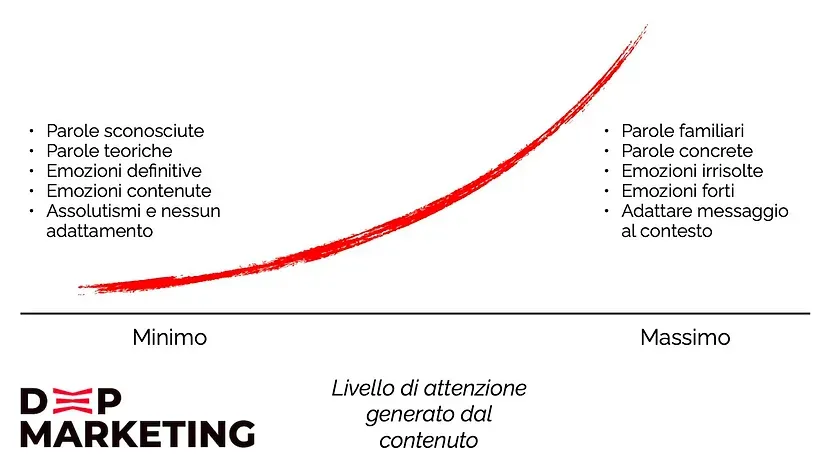
Familiarity captures attention but is not enough to fix the message. Chip Heath and Dan Heath, in Made to Stick (2007), studied thousands of “sticky” ideas — urban myths, proverbs, advertising slogans, lessons — to understand what makes them memorable. The framework they produced, SUCCESs, identifies six characteristics: Simple, Unexpected, Concrete, Credible, Emotional, Stories.

The two most relevant columns for copy are simplicity (the core message must be reducible to a single sentence) and emotion. But useful emotion is not generic positive emotion: it's the kind that activates arousal. Jonah Berger, in his book Contagious: Why Things Catch On (2013) and in the companion paper in Journal of Marketing Research, demonstrated that content generating high-arousal emotions — awe, outrage, anxiety, excitement — gets shared far more than content producing sadness or satisfaction.

Implication for copy: a headline that activates curiosity, urgency or surprise beats one that merely communicates a neutral benefit. No need to resort to clickbait: just transform a flat promise (“discover our services”) into a promise with tension (“why 78% of SMBs waste marketing budget — and how to avoid it”).

Priming and context: nearby words matter

Priming is the phenomenon whereby exposure to a stimulus influences the response to a subsequent stimulus without the subject being aware of it. Kahneman dedicates an entire chapter of Thinking, Fast and Slow to priming effects on perception and decision. A word “activates” related concepts in the reader's semantic network, making them more accessible for decisions immediately afterward.

Classic example: if a sales page frequently mentions words like “savings”, “guarantee”, “safe”, the reader will evaluate the offer through a low-risk lens. If the same information is presented with words like “gain”, “potential”, “growth”, the same offer is evaluated as an opportunity. The product doesn't change: the frame changes. Professional copywriters choose words not for their isolated meaning but for the network of concepts they activate.

In B2B this means avoiding unintended negative frames. Writing “no more cyberattack risks” activates the attack concept; writing “complete 24/7 protection” activates the protection concept. Same benefit, opposite psychological effect.

Person writing in a notebook with a blue pen — scientific copywriting and word choice

Scientific headline: the operational checklist

  1. One single idea. If you have to say two things, make two different headlines in A/B test.
  2. Short high-frequency words. Replace every word >3 syllables with a more common alternative, unless the technical term is required by context.
  3. Numerical concreteness. “Save 30%” beats “optimize costs”.
  4. One identifiable emotion. Curiosity, urgency, surprise, relief. Avoid neutral.
  5. Concrete specificity. “7 copywriting mistakes” beats “common copywriting mistakes”.
  6. Testable promise. The reader must be able to picture the result.
  7. Length under 65 characters. Exceed this limit and the headline gets truncated in social feeds and SERP meta.
  8. Priming consistent with the body. The first 10 words of the body must extend the headline's words, not contradict them.

Common mistakes that kill cognitive fluency

Three categories of errors recur in English copy and account for 90% of bounce cases on landing pages. First, corporate jargon: “innovative solutions”, “holistic approach”, “strategic partner”, “added value”. Words that mean nothing because everyone uses them to say anything. The reader recognizes them as noise and skips to the next paragraph, if there is one; otherwise they close the page.

Second, the complexity-as-proof-of-competence fallacy. The naive intuition says: “if I write difficult I sound more competent”. Research says the opposite. Daniel Oppenheimer published in 2006 in Applied Cognitive Psychology a paper with an explicit title: Consequences of Erudite Vernacular Utilized Irrespective of Necessity. Experimental conclusion: those who write with complex words when unnecessary are judged less intelligent, not more.

Third, passive voice and nominalization. “Process optimization will be carried out by our team” is bad English and bad copy. “Our team optimizes the process” is shorter, clearer, activates System 1. Nominalizing (turning verbs into nouns) systematically increases cognitive density without adding information.

Need scientific copy that converts?

Deep Marketing designs persuasive content for social, ads and landing pages based on the principles of cognitive fluency, System 1 and priming documented in peer-reviewed research. Request an audit of your copy or explore our social and content consulting to turn generic copy into messages that capture attention and convert.

Sources and References

Share

Pronto a crescere.

Parliamo del tuo progetto. Trasformeremo insieme i dati in risultati concreti per il tuo business.