
In summary: Brand architecture, formalized by David Aaker and Erich Joachimsthaler in their Brand Relationship Spectrum, comprises four main models: Branded House, Sub-Brands, House of Brands, and Endorsed Brands. Empirical studies confirm that Branded House and Sub-Brands strategies generate higher stock returns compared to House of Brands and Endorsed Brands. For SMEs, the most effective choice is almost always the Branded House, which concentrates investments on a single strong brand while avoiding resource fragmentation. The House of Brands model (like P&G or Luxottica) only makes sense for large companies with diversified portfolios and very high marketing budgets. Having too many brands is one of the most costly and frequent mistakes for small businesses.
This article is by Francesco Galvani, CEO of Deep Marketing, science communicator, anti-misinformation advocate, and branding strategy instructor.
What is Brand Architecture
In the world of marketing and branding, brand architecture plays a crucial role in defining a company's strategy and structure. Brand architecture determines how brands are organized, positioned, and communicated to consumers. Choosing the right brand architecture is essential for creating a coherent and recognizable market presence.
And for maximizing the effectiveness of marketing campaigns.
In this article, we will explore the different types of brand architecture, analyzing their pros and cons. We will also provide specific advice for small and medium-sized enterprises (SMEs), highlighting the importance of relying on a professional marketing agency like Deep Marketing to avoid common mistakes, such as having too many brands.
It should be noted that in our country there is an increasingly blatant and chronic misunderstanding of these topics, often oversimplified with suicidal advice derived from brand positioning, a pseudoscientific theory developed by Al Ries and Jack Trout in the late 1970s and repeatedly debunked by research. The biggest problem with this school of thought is the incentive to create many different brands, even for small companies. In this article, you will understand why this is a terrible idea and why so many companies that follow this approach end up going under.
Let's look at the different possible brand architectures:
- Branded House
- Sub-Brands
- House of Brands
- Endorsed Brands
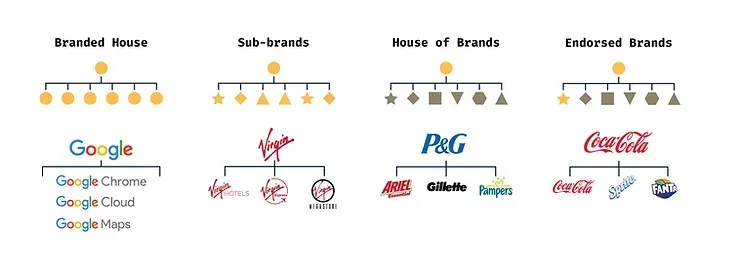
Branded House
The Branded House architecture is characterized by a single umbrella brand that covers all the company's products and services. This approach allows marketing and communication efforts to be concentrated on a single brand, creating a strong identity and recognition.
Not only small businesses, but also large companies skillfully leverage this approach.
Google is an excellent example of a Branded House. All the company's products and services, such as Gmail, Google Maps, YouTube, and Android, are associated with the main "Google" brand, both in terms of logo and brand name reference. This approach has allowed Google to create a coherent and recognizable brand identity worldwide.
Advantages of the Branded House
Disadvantages of the Branded House
- Risk of brand dilution if the products are too different
- Difficulty in differentiating products within the same range
- Potential confusion for consumers if the products are too different
It is clear that these disadvantages primarily affect larger players and represent a decidedly limited risk for small brands.
Sub-Brands
The Sub-Brands architecture involves a main brand that serves as an umbrella for a series of secondary brands or sub-brands. These sub-brands are often associated with specific product or service lines within the company.
Virgin is a classic example of Sub-Brands architecture. The main "Virgin" brand is accompanied by a series of sub-brands such as Virgin Atlantic (airline), Virgin Mobile (mobile telephony), Virgin Holidays (travel), and Virgin Money (financial services).
Each sub-brand has its own logo with independent concepts, fonts, and graphic elements, although the continuous inclusion of the parent brand (such as "Virgin") tends to always bring perception back to a single family of expectations and brand assets memorized by customers.
Advantages of Sub-Brand Architecture
- Differentiation of products and services
- Flexibility in market positioning
- Ability to expand into new sectors while maintaining the connection to the main brand
Disadvantages of Sub-Brands
- Potential confusion for consumers if the sub-brands are too different
- Need for marketing investments to promote both the main brand and the sub-brands
- Risk of diluting the main brand if the sub-brands are not managed properly
As is easy to see, moving from a branded house to sub-brands involves a significant initial visual branding effort. Not only do we need to create different brands with their own identities, but these brands must in turn be able to accommodate the parent brand in a smooth, coherent, and visually appealing way.
An extremely difficult task even for a highly experienced art director.
House of Brands
The House of Brands architecture involves a company managing a series of independent brands, each with its own identity and market positioning. This strategy is often adopted by large companies with a diversified portfolio of products and services.
Procter & Gamble is an iconic and very well-known example of a House of Brands. The company manages a vast range of independent brands such as Tide, Pampers, Gillette, Pantene, Oral-B, and Bounty, each with its own identity and market positioning.
Depending on the source, the main brand corresponds to the "corporate brand," which often uses its own communication and its own marketing budget.
It is very interesting to note that consumers often do not know that behind one of the product or service brands there is a corporate brand like P&G. Have you ever thought about the fact that Procter & Gamble is behind Oral-B?
In my career, I worked for 4 years at one of the most well-known Italian House of Brands, Luxottica. Luxottica is the corporate brand behind product brands such as Ray-Ban, Persol, and Vogue Eyewear.
Advantages of the House of Brands
- Deep differentiation of products and services
- Flexibility in market positioning
- Ability to acquire new brands without impacting the company's identity
- Ability to cover more and more markets naturally
Disadvantages of the House of Brands
- High marketing costs to promote each individual brand
- Potential cannibalization among the company's brands
- Difficulty in creating marketing and communication synergies
- Need to spend significant resources and energy to also build the corporate brand
It is easy to understand that the House of Brands only makes sense for extremely important, wealthy, and competitive companies. The purpose is to have a "monstrous" machine capable of easily and continuously absorbing new market segments and new markets without any risk to the rest of the company.

Endorsed Brands
The Endorsed Brands architecture combines elements of both the Branded House and House of Brands strategies. In this approach, a main brand acts as an endorser or guarantor for a series of secondary brands, which maintain a certain degree of independence.
Unlike the House of Brands, the corporate brand is also -- and above all -- a product or service brand, and does not exist solely as a financial and administrative entity.
Coca-Cola is probably the most well-known example of Endorsed Brands. The main "Coca-Cola" brand acts as a guarantor and supports -- in the minds of customers and financially -- a series of secondary brands such as Fanta, Sprite, Dasani, and Powerade, which maintain a certain independence but benefit from the association with the main brand.
The customer is not necessarily aware of the architectural association between Sprite and Coca-Cola, but it is constantly communicated to them more or less implicitly, and this transfer of "brand equity" greatly supports the weaker and less well-known brands. This also applies at the B2B commercial level.
Advantages of Endorsed Brands
- Differentiation of products and services
- Value transfer from the main brand to secondary brands
- Flexibility in market positioning
Disadvantages of Endorsed Brands
- Need for marketing investments to promote both the main brand and the secondary brands
- Risk of diluting the main brand if the secondary brands are not managed properly
- Potential confusion for consumers if the secondary brands are too different
- Extreme management complexity
- Sophisticated marketing required to combine brand distinction with brand associations
It is clear: the endorsement approach is only suitable for the highest and most complex levels of structured and multinational companies.
Advice for SMEs
For small and medium-sized enterprises (SMEs), choosing the most appropriate brand architecture is essential to ensure a coherent and recognizable market presence. In general, it is advisable to adopt a simple approach and to rely on a professional marketing agency like Deep Marketing to avoid common mistakes, such as having too many brands.
Let's look at some thorny issues and my personal recommendations.
Choose Branded House or Sub-Brands
For most SMEs, the Branded House or Sub-Brands architecture represents the most appropriate choice. These strategies allow marketing and communication efforts to be concentrated on a limited number of brands, creating a strong identity and recognition.
The Branded House architecture is particularly suited for SMEs with a relatively homogeneous product or service offering. This approach allows you to maximize marketing and communication synergies, reducing costs and maximizing market impact.
On the other hand, the Sub-Brands architecture can be an appropriate choice for SMEs with a more diversified product or service offering. This strategy allows you to differentiate products or business lines while maintaining the connection to the main brand.
Recently, my agency Deep Marketing encountered a case that is becoming increasingly common among our potential Italian clients: a small company whose previous agencies (predictably influenced by the pseudoscience of brand positioning) had them create two independent brands, even though the two underlying products were simply two industrial machines for two sub-segments of the same market. A textbook case of perfect incompetence in strategic marketing.
This unfortunate potential client has been stuck for years with a pointless double expense for everything -- from social media to advertising, and even trade show booths! An absurd waste of energy that is also counterproductive because it prevents the creation of stable and robust memory structures in customers' minds.
We cannot always "save" these businesses, especially if the excess of brands has existed for years and is ingrained in the minds of some executives or in commercial processes. Many fail; some survive, but with the handbrake on.
Avoid the House of Brands
For SMEs, adopting a House of Brands architecture is generally discouraged, unless the company has an extremely diversified portfolio of products or services and plenty of money to spend. This strategy requires significant marketing investments to promote each individual brand and can lead to a fragmentation of corporate identity.
Remember that the House of Brands involves a corporate brand that must have its own independent existence with a purely corporate purpose. An expenditure of resources that is simply ridiculous for a small or medium-sized business.
Rely on a professional marketing agency
Regardless of the brand architecture chosen, SMEs are strongly advised to rely on a professional marketing agency like Deep Marketing. Agencies like ours have professionals with at least 20 years of industry expertise in strategy and do not follow the "trends" and fanciful or pseudoscientific theories that come and go.
In Italy there are many players with the experience and skills needed to guide companies in choosing the most appropriate brand architecture and developing a coherent and effective branding strategy. It is up to the client to choose wisely, without being "lured" by the sirens.
Working with a professional marketing agency that stays away from "gurus" allows SMEs to avoid common mistakes, such as having too many brands or an incoherent branding strategy. Furthermore, agencies can provide an external and objective perspective, helping companies make informed decisions and maximize return on marketing investments.
A simple rule: if you know someone more for their face than their arguments, and more for their fame than that of their clients, you can be fairly certain you should stay away. The best marketers are far less visible than their clients. We are "entities" that stay behind the scenes, not on stage. Our clients are the ones on stage.
Final thoughts
Brand architecture is a crucial element for the success of any company, regardless of its size or the industry it operates in. Choosing the right brand architecture allows you to create a coherent and recognizable market presence, facilitating communication with consumers and maximizing the effectiveness of marketing campaigns.
In this article, we have explored the different types of brand architecture, analyzing their pros and cons. We have provided specific advice for small and medium-sized enterprises, highlighting the importance of adopting a simple approach and relying on a professional marketing agency to avoid common mistakes.
Remember, the choice of brand architecture is not a decision to be taken lightly. It requires a deep understanding of the market, consumers, and business objectives. However, with a well-planned strategy and the assistance of marketing professionals, it is possible to create a strong and distinctive brand identity that will translate into a lasting competitive advantage.
Sources and References
- How Brands Are Built — Brand Architecture Beyond House of Brands and Branded House
- BrandStruck — Brand Architecture: The Difference Between a Branded House and a House of Brands
- Appinio — What is Brand Architecture? Models, Strategy, Examples
- Erich Joachimsthaler — Branded House or House of Brands: What Wins?
- The Institute of Branding — Crafting a Comprehensive Brand Portfolio Strategy (PDF)
- Academia.edu — Aaker's Brand Architecture (PDF)