
Blue Ocean Strategy is an innovative approach to business strategy that focuses on creating new, uncontested market spaces, making the competition irrelevant. Developed by W. Chan Kim and Renee Mauborgne, professors at INSEAD, this strategy challenges the traditional competitive approach of companies fighting for market share in crowded, mature industries -- the so-called "red oceans."
Blue Ocean Strategy proposes instead to create new markets -- "blue oceans" -- where competition does not yet exist. This is achieved through value innovation, the simultaneous pursuit of differentiation and low cost, expanding market boundaries and capturing new demand.
This strategy is particularly well-suited for small and medium-sized enterprises (SMEs), which often lack the resources to compete on equal footing with major players in existing markets. By creating their own blue ocean, SMEs can grow rapidly and profitably while avoiding direct competition.
Key Principles and What Makes Blue Ocean Unique
It is worth noting that the idea of creating low-competition market spaces is not new and did not originate with Blue Ocean. Far from it. In some markets, due to certain self-styled gurus who were former salespeople, Brand Positioning recently gained popularity -- a strategy developed by consultants Jack Trout and Al Ries in the 1970s that aimed to achieve the same results as Blue Ocean, unfortunately through naive theories that have been repeatedly debunked by science and market research. Brand Positioning is now considered pseudoscience on par with horoscopes, while Blue Ocean Strategy is backed by rock-solid evidence and exceptional case studies.
We should note that the book "Digital Deep Marketing Remastered," one of the volumes that introduced our agency to the Italian public, serves as a manual that draws some insights from Blue Ocean but simplifies and makes them actionable for the digital world, combining them with evidence from cognitive psychology.
Key Principles of Blue Ocean Strategy
- Reconstruct market boundaries: Look beyond traditional definitions of your industry and identify untapped opportunities.
- Focus on the big picture, not the numbers: Do not let data alone guide you -- consider trends and qualitative insights as well.
- Reach beyond existing demand: Target non-customers and create new demand.
- Get the strategic sequence right: Align utility, price, cost, and adoption from the start.
- Overcome key organizational hurdles: Align your people, processes, and technology to support your strategy.
- Build execution into strategy: Planning and execution must go hand in hand.
Steps to Implement Blue Ocean Strategy
Let's walk through how your SME or the company you manage can effectively and successfully develop a Blue Ocean approach. Step by step:
Step 0: The Team
First and foremost, it is essential to build the right team to lead the initiative, with people from diverse functions and levels within the organization. The team must be motivated, open to change, and willing to challenge the status quo.
Step 1: Draw Your Current Value Curve
The Value Curve is a tool that maps your company's performance against the key competitive factors in your industry. Start by identifying these factors and evaluating your performance on each one. This will give you a clear understanding of where you currently stand in the market.
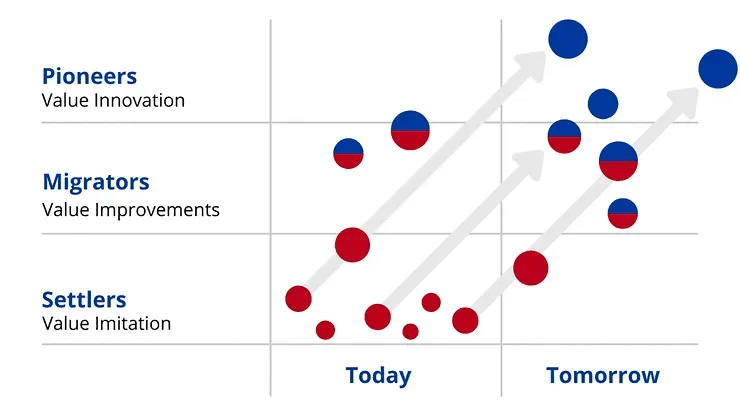
You should choose the right area on which to focus your Blue Ocean effort. You need to identify the business areas with the greatest potential for value creation and the fewest organizational constraints. Tools like the Pioneer-Migrator-Settler Map can help pinpoint the most promising opportunities.
Credits: Chan Kim and Renee Mauborgne, blueoceanstrategy.com
The first column represents the current state of the portfolio, while the second column depicts the desired future state. Marketers can use the PMS Map to chart the business units or product/service lines within a group.
- Pioneers are business entities or offerings that deliver unprecedented value to customers. Their value curve diverges sharply from competitors, and they enjoy a large market following. These businesses adopt Blue Ocean Strategies and represent the most powerful levers for profitable growth.
- Migrators are businesses or offerings that deliver superior value compared to rivals, but not disruptive value: they give customers more for less, without revolutionizing the industry's key competitive parameters.
- Settlers are offerings that deliver roughly the same value to customers as competitors. These are the so-called "me-too" businesses. While they are often today's cash cows, settlers generally will not contribute significantly to a company's future growth, as they are trapped in the red ocean of competition.
Step 2: Identify Untapped Opportunities
Start from the PMS Map and look beyond your industry to identify untapped opportunities.
Consider alternative industries, strategic groups within your industry, the buyer chain, complementary product and service offerings, functional-emotional appeal for buyers, and even the dimension of time. Ask yourself questions like:
- "What industry assumptions can we challenge?"
- "What customer needs are still unmet?"
Step 3: Redesign Your Value Curve
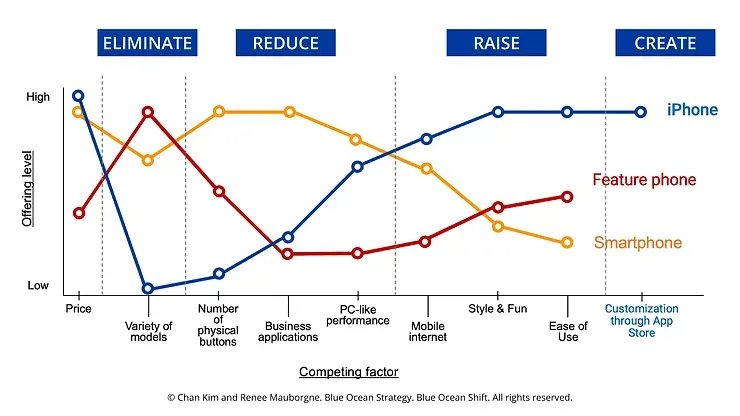
Based on the opportunities you have identified, redesign your Value Curve. Consider which factors you should eliminate, reduce, raise, or create. The goal is to offer unprecedented value to customers, making the competition irrelevant. We will see in the examples below how to implement this section correctly.
In detail:
- Eliminate. Identify the factors that the industry takes for granted but that no longer deliver value or even have a negative impact. For example, costs, features, or services that are no longer necessary. Drastically eliminate these factors to differentiate yourself and reduce your cost structure.
- Reduce. Identify the factors on which the industry tends to overinvest in an attempt to beat the competition, going beyond what customers actually need. Significantly reduce your investment and effort on these factors to save resources.
- Raise. Determine the factors that should be raised well above industry standards to differentiate and create value for customers. Decisively increase your investment and focus on these key factors.
- Create. Discover entirely new sources of value for customers, creating factors the industry has never offered. Create these new factors to attract new demand and radically differentiate yourself from competitors.
Credits: Chan Kim and Renee Mauborgne, blueoceanstrategy.com
Step 4: Test and Refine Your Strategy
Before launching your new strategy at full scale, test it with a small customer segment. Collect feedback and refine your strategy accordingly. This will help you mitigate risk and ensure that your Blue Ocean strategy resonates with the target market.
This phase aligns perfectly with Growth Hacking processes for startups and new business areas covered in the book "Deep Marketing Growth Hacking."

Step 5: Align Your Organization
Successful implementation of a Blue Ocean strategy requires alignment across your entire organization. Ensure that your people, processes, and technology are aligned to support your new strategic direction. This may require reallocating resources, training staff, and adopting new technologies.
This is why the core working team must be chosen wisely. They should be people with leadership skills and deep vertical expertise.
Step 6: Launch and Iterate
Once your strategy has been tested and refined, it is time to launch at full scale. However, remember that Blue Ocean Strategy is not a one-time event. It requires continuous iteration and adaptation in response to changing market conditions. Stay alert to new opportunities and be ready to adjust course if necessary.
Success Stories and Case Studies
Below are three "classic" case studies to help you understand how to think in a "Blue Ocean" mindset.
Cirque du Soleil
One of the most famous examples of Blue Ocean Strategy is Cirque du Soleil, which reinvented the circus industry by targeting a new market space: theatrical entertainment for adults willing to pay a premium price for a unique artistic experience.
Instead of competing with traditional circuses based on animals, big tops, and clowns, Cirque eliminated or reduced these elements, adding live music and dance, captivating storylines, and artistic performances in refined venues. It thus attracted a new audience of adults, corporate clients, and high-spending tourists.
In 20 years, Cirque du Soleil reached revenues equal to those achieved by industry leader Barnum & Bailey in 100 years, creating a blue ocean in live entertainment.
Nintendo Wii
Another example is the Nintendo Wii console, which created a new market in gaming by targeting casual gamers, particularly women and the elderly, rather than the traditional male gamer demographic.
The Wii introduced an innovative motion-based controller, intuitive and fun games like Wii Sports, and a simple, appealing design. It made gaming accessible to the entire family, creating new demand.
Launched in 2006, within a year the Wii outsold consoles from Sony and Microsoft, the technological leaders in the industry, demonstrating how value innovation can beat computational power.
[yellow tail]
In the crowded wine industry, [yellow tail], an Australian brand, created a blue ocean by focusing on simplicity and fun rather than the complexity and snobbery of premium wines.
[yellow tail] eliminated technical jargon, grape varieties, and vintages from its labels, creating just two wines (one red and one white) that are easy to drink. It simplified the supply chain by relying on a few key suppliers. And it created a playful, informal brand that appeals to "beer drinkers" who are intimidated by wine.
Launched in 2001, within two years [yellow tail] became the best-selling imported wine in the USA, creating a new segment of "simple, fun wines" that expanded the market.
Frequently Asked Questions About Blue Ocean Strategy
Does Blue Ocean Strategy apply only to certain industries or companies?
No, Blue Ocean Strategy is a universal approach that can be applied in any industry, whether manufacturing or services, high-tech or low-tech, consumer or B2B. Success stories can be found across the most diverse fields, from Cirque du Soleil in entertainment, to the Nintendo Wii in gaming, to [yellow tail] in wine.
What matters is not the industry itself, but the ability to challenge market boundaries and taken-for-granted assumptions in order to create an innovative value offering. Even mature and stagnant industries can be revitalized by Blue Ocean moves that redefine the rules of the game.
Do you need to be a startup to create a blue ocean?
No, both startups and established companies can create blue oceans. In fact, it is often incumbents with deep industry knowledge who identify and capitalize on new market opportunities.
Cases like the Nintendo Wii in gaming or Starbucks in coffee show how industry leaders can continuously reinvent their business through Blue Ocean moves. The key is maintaining an entrepreneurial mindset open to innovation, even when you are number one.
How long does it take to implement a Blue Ocean strategy?
Implementing a Blue Ocean strategy can take anywhere from a few months to a year or more, depending on the size and complexity of your organization and the scope of your new strategy.
How can I overcome internal resistance to change?
Clear communication, employee involvement, and strong leadership are essential to overcoming internal resistance. Make sure everyone understands the reasoning behind your new strategy and their role in making it a reality.
How do I measure the success of my Blue Ocean strategy?
Success can be measured in terms of new customers acquired, revenue growth, profitability, and market share. However, also consider qualitative metrics such as customer satisfaction and brand recognition.
Do you need new technology to create a blue ocean?
No, Blue Ocean Strategy does not necessarily require high technology or cutting-edge R&D. Blue oceans often emerge from creatively recombining existing technologies to solve customer problems in new ways.
For example, Cirque du Soleil combined elements of traditional circus with theater and dance without introducing any new technology. The key is value innovation, not technology innovation per se.
Do Blue Oceans last forever?
No, sooner or later every Blue Ocean becomes a Red Ocean as competitors imitate the successful strategy and erode the first-mover advantages. However, companies that continuously create new blue oceans can thrive in the long term.
Companies like Apple, Amazon, or Salesforce have made value innovation a strategic capability, systematically creating new markets and growing sustainably. The challenge is to institutionalize a process of non-disruptive creation that continuously renews the business.
Where Can I Learn More?
As always in these cases, we provide essential reading to continue your study:
[1] https://www.blueoceanstrategy.com/blog/five-steps-making-blue-ocean-shift/
[2] https://www.blueoceanstrategy.com/blog/7-powerful-blue-ocean-strategy-examples/
[3] https://www.blueoceanstrategy.com/tools/red-ocean-vs-blue-ocean-strategy/
[4] https://blog.hubspot.com/blog/tabid/6307/bid/54/blue-ocean-strategy-a-small-business-case-study.aspx
[5] https://www.blueoceanstrategy.com/blog/blue-ocean-qa-questions-answered/
[6] https://www.blueoceanstrategy.com/tools/5-steps-to-making-a-blue-ocean-shift/
[7] https://arounda.agency/blog/top-10-blue-ocean-strategy-examples
[8] https://www.blueoceanstrategy.com/what-is-blue-ocean-strategy/
[9] https://www.blueoceanstrategy.com/teaching-materials/all-cases/
[10] https://www.blueoceanstrategy.com/blue-ocean-shift-question-and-answer/
[13] https://www.cascade.app/blog/blue-ocean-vs-red-ocean-strategy
[14] https://www.youtube.com/playlist?list=PL6xJIk7SXpnFF1o-YRp38qlKh4GaJUiJS
[15] https://www.csus.edu/center/carlsen/_internal/_documents/tools/blue-ocean/blue-ocean-qa.pdf
[16] https://www.linkedin.com/advice/1/what-steps-create-blue-ocean-strategy-skills-strategy
[17] https://www.blueoceanstrategy.com/blue-ocean-strategy-examples/