
In short: How Brands Grow by Byron Sharp (Oxford University Press, 2010) argues, with decades of Ehrenberg-Bass Institute data, that a brand grows mainly by winning more buyers, not by making the ones it has more loyal. To do that it must be easy to remember at the moment of purchase (mental availability) and easy to find and buy (physical availability), with distinctive assets kept consistent over time. The sequel, How Brands Grow Part 2 by Jenni Romaniuk and Sharp (2016, revised in 2021 with a B2B chapter), extends the same laws to services, durables, emerging markets and luxury.
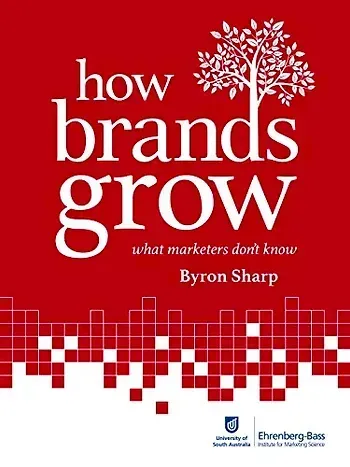
Few marketing books have changed how people work as much as How Brands Grow: What Marketers Don't Know by Byron Sharp. Published in 2010 by Oxford University Press, written by Sharp «and the researchers of the Ehrenberg-Bass Institute», it gathers empirical laws observed across many categories and countries and uses them to answer practical questions: how brands grow, how advertising really works, what price promotions do, how much loyalty programs matter. Here is a summary of the main ideas and how to apply them in a company without a multinational's budget.
What is How Brands Grow about?
How brands really grow, measured on buying behaviour rather than managers' opinions. Sharp and his institute, the Ehrenberg-Bass Institute for Marketing Science at the University of South Australia, start from panel and survey data collected over decades and find patterns that repeat from one category to the next. The book calls them laws, and derives from them what is worth doing.
The thesis that sparked debate is simple: big brands are big because more people buy them, not because their customers are much more loyal. So the main road to growth is raising penetration, the number of people who buy the brand in a period, rather than squeezing existing buyers.
What are the book's main ideas?
There are five, and they hold each other up.
| Idea | What it says | What it changes in practice |
|---|---|---|
| Growth through penetration | Brands grow mainly by adding buyers | Budget goes to reaching people who don't buy you yet |
| Double jeopardy | Small brands have fewer buyers, and those buyers are also slightly less loyal | Loyalty follows size: you can't buy it on its own |
| Divided loyalty | Almost everyone buys several brands in the same category | Your customers are also your competitors' customers |
| Mental and physical availability | The brand that comes to mind and is easy to find at the moment of purchase wins | Continuous communication and broad distribution, together |
| Distinctiveness before differentiation | Being recognisable matters more than seeming different | Colours, logo, shapes and sounds kept constant for years |
Source: Byron Sharp, How Brands Grow, Oxford University Press, 2010.
Why isn't loyalty enough to grow a brand?
Because loyalty moves little and follows brand size. That is the double jeopardy law, documented by Andrew Ehrenberg and colleagues well before the book: a small brand is penalised twice, it has fewer customers and those customers buy it a little less often. A loyalty program speaks mostly to people who already buy you often, while growth comes from the many who buy you rarely or never.
That is why Sharp insists on light buyers, people who buy the category and your brand a few times a year: they are the majority of almost every brand's customer base, and winning new ones moves the numbers more than any initiative aimed at the most loyal. The full reasoning is in our guide to light buyers.
What are mental and physical availability?
Mental availability is the likelihood that the brand comes to mind when someone is in a buying situation. Physical availability is how easily they find and buy it, in store, online, on the phone. You need both: a brand that is remembered but can't be found loses the sale, one that is everywhere but forgotten doesn't get chosen.
The institute's later work made mental availability measurable through category entry points, the situations that make people think of a category: Jenni Romaniuk developed them in Better Brand Health (Oxford University Press, 2023). The full comparison of the two is in our guide to mental and physical availability.
Why does Sharp prefer distinctiveness to differentiation?
Because, according to the book's data, customers see competing brands as not very different from each other, and choose the one they recognise fastest. Rather than chasing a difference few people notice, it pays to build distinctive brand assets: a colour, a shape, a character, a sound that says the brand's name even when the name can't be read. They only work if they stay the same for years.
It doesn't mean the product needn't be good or different. It means communication must first get recognised and remembered, and only then explain why the product is better.
What does How Brands Grow Part 2 add?
It tests the same laws where critics said they didn't apply. How Brands Grow Part 2, by Jenni Romaniuk and Byron Sharp (Oxford University Press, 2016), checks them on emerging markets, services, durables, new brands and luxury; the revised 2021 edition adds a chapter on B2B. It also treats the building of mental availability and distinctive assets in a more operational way.
The reception wasn't unanimous. A review in the International Journal of Market Research (Alan Wilson, 2016) found much of it useful but judged the second volume weaker than the first. If you are starting from scratch, start with the first.
How do you apply How Brands Grow to a small business?
With four concrete choices that don't need a multinational's budget.
Talk to the whole category, not a niche. A campaign's audience is everyone who might buy the category in the coming months, not the ideal customer described in a buyer persona. Narrow targeting cuts apparent waste and growth along with it.
Don't disappear. Mental availability wears off: a continuous presence, even a small one, protects more than one strong campaign a year followed by silence.
Pick your assets and don't change them. Colour, logo, tone, maybe a line: decide them, use them everywhere and resist refreshing them every season. The people bored of them are the ones who see them in the office every day, not the market.
Make yourself easy to buy. For a small business, physical availability means being where the customer looks: an up-to-date Google profile, a website that loads fast, a phone that gets answered, a product present in the right channels. A good campaign landing on a slow website burns the work done.
FAQ
Who wrote How Brands Grow?
Byron Sharp, professor of marketing science and director of the Ehrenberg-Bass Institute at the University of South Australia, with the institute's researchers. The book was published in 2010 by Oxford University Press.
What is the main idea of How Brands Grow?
That brands grow mainly by increasing the number of buyers, not the loyalty of existing ones. Doing that takes mental availability, physical availability and distinctive assets kept consistent over time.
Does How Brands Grow apply to B2B?
Yes. The revised edition of How Brands Grow Part 2 (2021) has a chapter on B2B, and the Ehrenberg-Bass Institute has applied the same principles to business markets, for example with John Dawes's 95-5 rule.
What criticism has How Brands Grow received?
The most common concerns the weight given to penetration over loyalty and the generalisation of the laws to every category. On that debate, and the comparison with Al Ries's positioning, see our dedicated article.
Sources and references
- Sharp, B. (2010). How Brands Grow: What Marketers Don't Know. Oxford University Press. ISBN 9780195573565.
- Romaniuk, J. & Sharp, B. (2021). How Brands Grow Part 2, revised edition. Oxford University Press.
- Wilson, A. (2016). Book review: How Brands Grow Part 2. International Journal of Market Research.
- Romaniuk, J. (2023). Better Brand Health. Oxford University Press.
- Ehrenberg-Bass Institute. How do you measure How Brands Grow?
- Ehrenberg-Bass Institute (2021). The 95:5 rule is the new 60:40 rule.