
In short
- The five psychology books we recommend for understanding people are "Thinking, Fast and Slow" by Daniel Kahneman, "Influence" by Robert Cialdini, "Emotional Intelligence" by Daniel Goleman, "Predictably Irrational" by Dan Ariely and "The Power of Habit" by Charles Duhigg.
- Together they explain how we decide, why we say yes, how much emotions weigh, why we make the same mistakes again and again, and how habits form.
- Not everything has aged well: in 2017 Kahneman accepted the criticism of his chapter on priming, and in 2021 PNAS retracted a study co-authored by Ariely because it relied on fabricated data (sources: Replicability-Index, Data Colada).
- For each book you get the editions, what it teaches people who work in marketing, and the limit to know before applying it.
Doing marketing every day means asking questions about people: why one visitor completes the order while another abandons the cart, why a price changed by a little stops sales, what makes someone buy again. These five books give those questions a firmer base than gut feeling, and they are readable for anyone running a business without a background in psychology.

| Book | Author | First published | Italian edition | The question it answers |
|---|---|---|---|---|
| Thinking, Fast and Slow | Daniel Kahneman | 2011 | Mondadori, 2012 | How do we really decide? |
| Influence | Robert Cialdini | 1984 | Giunti | Why do we say yes? |
| Emotional Intelligence | Daniel Goleman | 1995 | Rizzoli, 1996 | How much do emotions weigh? |
| Predictably Irrational | Dan Ariely | 2008 | Rizzoli, 2008 | Why do we keep making the same mistakes? |
| The Power of Habit | Charles Duhigg | 2012 | Corbaccio, 2012 | How is a habit formed and changed? |
1. "Thinking, Fast and Slow" by Daniel Kahneman: how do we really decide?
Most of our everyday choices run on fast mental shortcuts we are barely aware of. Daniel Kahneman, winner of the 2002 Nobel Prize in Economics, who died in 2024, splits thinking into two tracks: System 1, immediate, intuitive and emotional, and System 2, reflective, controlled and effortful. When you build a company's communication, remember that a large share of customers' choices goes through the first track, with its traps: the cognitive biases described in the book.
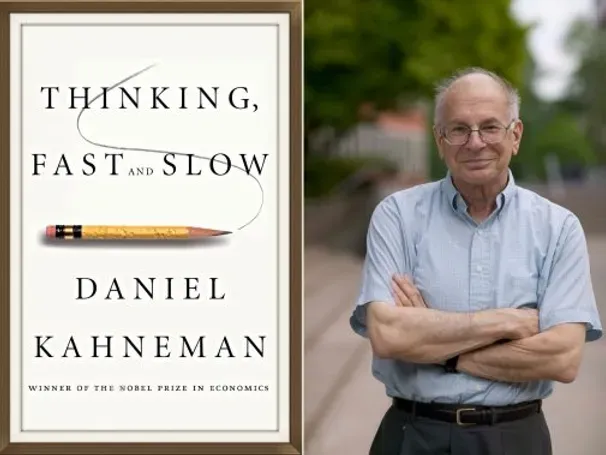
Italian edition: «Pensieri lenti e veloci», Mondadori, 2012, translated by Laura Serra (ISBN 9788804621089). On Amazon.
Why it is useful for marketing:
- It shows how consumers make purchasing decisions.
- It gives you cues for writing persuasive messages that speak to System 1.
- It teaches you to spot the judgment errors that affect our own strategic plans.
The limit to know: the section on behavioral priming rests on lab studies that later failed to replicate. In February 2017 Kahneman commented on the analysis by Schimmack, Heene and Kesavan, writing that he accepted its basic conclusions. The core of the book, the two systems and prospect theory, remains a reference.
2. "Influence" by Robert Cialdini: why do we say yes?
We say yes through automatic response patterns that anyone can trigger. Robert Cialdini, professor emeritus at Arizona State University, grouped them into six principles: reciprocity, commitment and consistency, social proof, liking, authority and scarcity. He explains how salespeople and advertisers use them and how to defend yourself when they are used on you.
In the expanded 2021 edition Cialdini added a seventh principle, unity: the sense of sharing the same identity.
Italian edition: «Le armi della persuasione. Come e perché si finisce col dire di sì», Giunti (digital edition 2010, ISBN 9788809764606). On Amazon.
Why it is useful for marketing:
- It explains the psychology behind customer reviews, guarantees and limited-availability messages.
- It suggests concrete ways to strengthen an offer.
- It helps separate honest communication from aggressive manipulation, which drives buyers away in the long run.
The limit to know: these principles do not work as mechanical tricks. Fake scarcity or doctored reviews destroy a brand's credibility, and the damage outweighs the revenue of a single order.
3. "Emotional Intelligence" by Daniel Goleman: how much do emotions weigh?
Feelings drive practical choices as strongly as logic does. Daniel Goleman made the concept of emotional intelligence accessible by breaking it into self-awareness, self-control, empathy and relationship skills. He writes that "in a very real sense we have two minds, one that thinks and one that feels."
Italian edition: «Intelligenza emotiva», Rizzoli, 1996; in BUR since 1999 (ISBN 9788817112994).
Why it is useful for marketing:
- It helps you put yourself in the shoes of the people your message is for.
- It gives you tools to stay calm in difficult conversations with demanding clients.
- It shows how a flawless proposal loses impact when it lacks human warmth.
The limit to know: this is a popular science book. The claim that these skills matter more than IQ for career success has drawn strong objections: treat it as a guide to better relationships, not a statistical certainty.
4. "Predictably Irrational" by Dan Ariely: why do we keep making the same mistakes?
Our mistakes follow constant, predictable paths. Dan Ariely, professor at Duke University, challenges the classic theory of the rational economic agent and shows, with clear and practical experiments, how anchoring shapes perceived value, how much power "free" has, and how adding a deliberately unattractive third option can steer the choice toward the most profitable product.
Italian edition: «Prevedibilmente irrazionale», Rizzoli, 2008, translated by Chicca Galli (ISBN 9788817025492). On Amazon.
Why it is useful for marketing:
- It explains why the same offer sells differently when its context changes.
- It offers precise criteria for organizing price lists, discounts and service bundles.
- It shows how framing affects the perception of cost.
The limit to know: in 2021 PNAS retracted a 2012 paper co-authored by Ariely on honesty in insurance forms, after the researchers at Data Colada showed that the field experiment data had been fabricated. The experiments in this book are separate from that episode, but it shows why you should check a study before turning it into an advertising investment.
5. "The Power of Habit" by Charles Duhigg: how is a habit formed and changed?
Every habit develops around a fixed sequence of cue, routine and reward. Charles Duhigg, a New York Times journalist, illustrates this loop through business cases, personal stories and well-known brands. His thesis: to change a behavior you change the central action and leave the cue and the reward as they were.
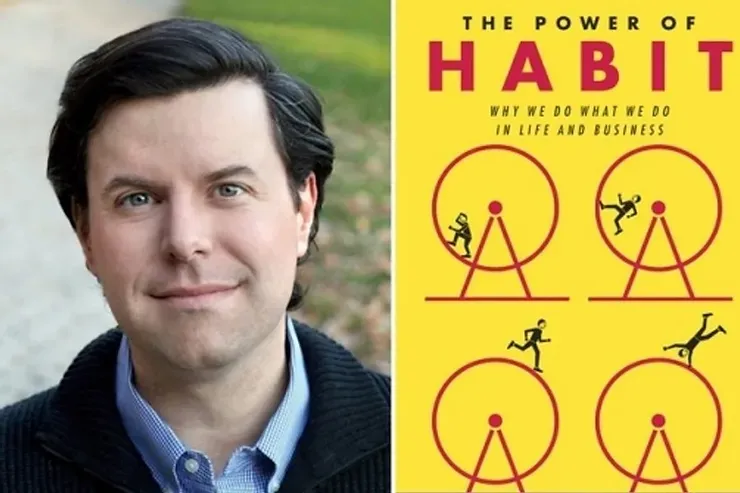
Italian edition: «La dittatura delle abitudini», Corbaccio, 2012; new edition 2019 (ISBN 9788867006977). On Amazon.
Why it is useful for marketing:
- It clarifies how buying habits form.
- It suggests ways to make a product part of the customer's day.
- It shows that loyalty programs hold up only when the promised reward arrives on time.
The limit to know: this is investigative journalism, not academic research. The loop is a working model, not a mathematical certainty.
How do you use these books in digital marketing?
Use them as lenses for reading sales data, not as instructions to follow blindly. Five concrete areas:
- Copywriting: Cialdini's principles help you choose which proof to put next to an offer.
- User experience: Kahneman's System 1 reminds you that a page must be understood without effort.
- Social content: Goleman's emotional intelligence helps you write for people, not for an abstract target.
- Pricing: Ariely's experiments show how much the way you present price lists and bundles matters.
- Retention: Duhigg's loop helps you design programs that become part of customers' routines.
The goal of commercial communication is solving real problems for buyers, not fooling them. Reading builds working hypotheses: then you test them, measure and correct.
Further reading: 10 Ads So Beautiful They Will Leave You Speechless and The Two Paths of Advertising Persuasion.
Frequently asked questions
What is the best psychology book to understand people?
We suggest starting with "Thinking, Fast and Slow" by Kahneman: it frames how people decide and makes the other books easier to follow.
Are these books suitable for people who have not studied psychology?
Yes, they are all written for a general audience. Kahneman requires the most concentration, Duhigg reads the fastest.
Which book helps salespeople the most?
"Influence" by Cialdini, because it breaks down the reasons that lead a buyer to accept a request.
Is the research in these books still valid?
Mostly yes, with known exceptions: Kahneman's chapter on social priming has been scaled back, and an Ariely study on honesty was formally retracted in 2021.
Sources
- Daniel Kahneman, facts, Nobel Prize in Economic Sciences 2002, NobelPrize.org.
- Schimmack, Heene, Kesavan, "Reconstruction of a Train Wreck: How Priming Research Went off the Rails", with Kahneman's comment of 14 February 2017, Replicability-Index.
- "The 'Godfather of Influence' has a new way to be more persuasive", W. P. Carey School of Business, Arizona State University, 10 May 2021.
- Data Colada, "[98] Evidence of Fraud in an Influential Field Experiment About Dishonesty", August 2021.
- «La dittatura delle abitudini», Corbaccio 2019, Il Libraio.
- «Pensieri lenti e veloci», Mondadori 2012, Libreria Coletti.
- «Intelligenza emotiva», BUR 1999, Open Library.
PS: the images in this article are AI generated.